This Photographer Found a Beautiful Vintage Angenieux Lens for Just $10

Sometimes the universe has a sense of humor. Other times, it hands you a $10 cinema lens that shouldn’t exist outside a collector’s dream and whispers, “Here, go make magic.” This is exactly what happened to Mathieu Stern, the intrepid lens hunter who just scored cinematic history for about the price of a nice latte.
A few weeks ago, while scouring eBay for weird, vintage optics, Mathieu Stern noticed a listing: “Projector Lens 70 mm F15”. Only three photos, a basic description, and the kind of vagueness that makes most collectors scroll past. But Stern’s instincts kicked in. This wasn’t an F15 lens. It was an Angenieux 70mm f/1.5 projection lens, one of the rarest projector optics ever made. Ten dollars later, it was his.

The lens arrived dirty and unassuming, but a closer inspection revealed no cracks, no fungus, just pristine, hidden potential, and then, the engraving: Angenieux. Stern’s jaw officially dropped.
Pierre Angenieux: Father of Modern Cinema Optics
Pierre Angenieux wasn’t just a lens maker. He was a magician of light, a French engineer whose company, founded in 1935, rewrote the rules of cinema. Angenieux lenses solved impossible problems, inventing the first practical zoom lens, pioneering the retrofocus design, and delivering optics so precise that Hollywood awarded them multiple Oscars. Directors from Godard to Truffaut liberated their cameras thanks to Angenieux lenses, running handheld through the streets of Paris, zooming slowly and elegantly, capturing life in motion like never before.
Legendary, compact, and obsessively sharp, Angenieux lenses weren’t just for movies. NASA even chose an Angenieux engine lens for the Ranger 7 mission, sending back the first high-resolution images of the lunar surface. Apollo 11 used Angenieux optics to film Armstrong’s historic first steps.
The Angenieux 70mm f/1.5 Projection Lens
The 70mm f/1.5 projection lens was initially designed for 16mm film projectors in theaters, offering an unusually wide aperture for its time. Unlike standard lenses, it had neither an aperture system nor a focusing mechanism. It was built to project bright images onto a screen, not capture them.
Optically, this lens is remarkable, featuring a six-element, four-group design that delivers a very large image circle, allowing it to cover even 16mm and 35mm film formats when adapted. The ultra-fast f/1.5 aperture allows for extreme low-light performance and unique depth-of-field characteristics. Projection lenses like this are rare because they were produced in very limited quantities and often overlooked by collectors. They are prized today for their ability to deliver dreamy subject separation, swirly bokeh, and razor-sharp centers when used with modern mirrorless cameras.


Projector Lenses: The Forgotten Goldmine
Vintage Angenieux lenses are usually out of reach for most collectors because they are rare and expensive, but projector lenses were often ignored. Stern cleaned the lens, removed the elements, flocked the barrel to reduce reflections, and even 3D-printed an adapter to make it focusable from infinity to macro. The front thread allowed a variable ND filter, enabling shooting wide open in bright sunlight.
“First, I completely cleaned the lens by removing the front and rear elements. While I was doing that, I took the opportunity to flock the inside of the barrel,” Stern explains.
“One big problem with any projector lens is that they were made to project images, not to capture them. The bare metal insides are highly reflective and will cause the footage to look washed out. To reduce reflections, I used the new experimental fine shut kiwami, a self- adhesive film that absorbs 99.9% of visible light and can stick inside the lens barrel. This will give me a better contrasted image.”
Stern has experience with DIY flocking lenses, with another video from a year ago demonstrating the technique and its surprising effectiveness at increasing natural contrast.
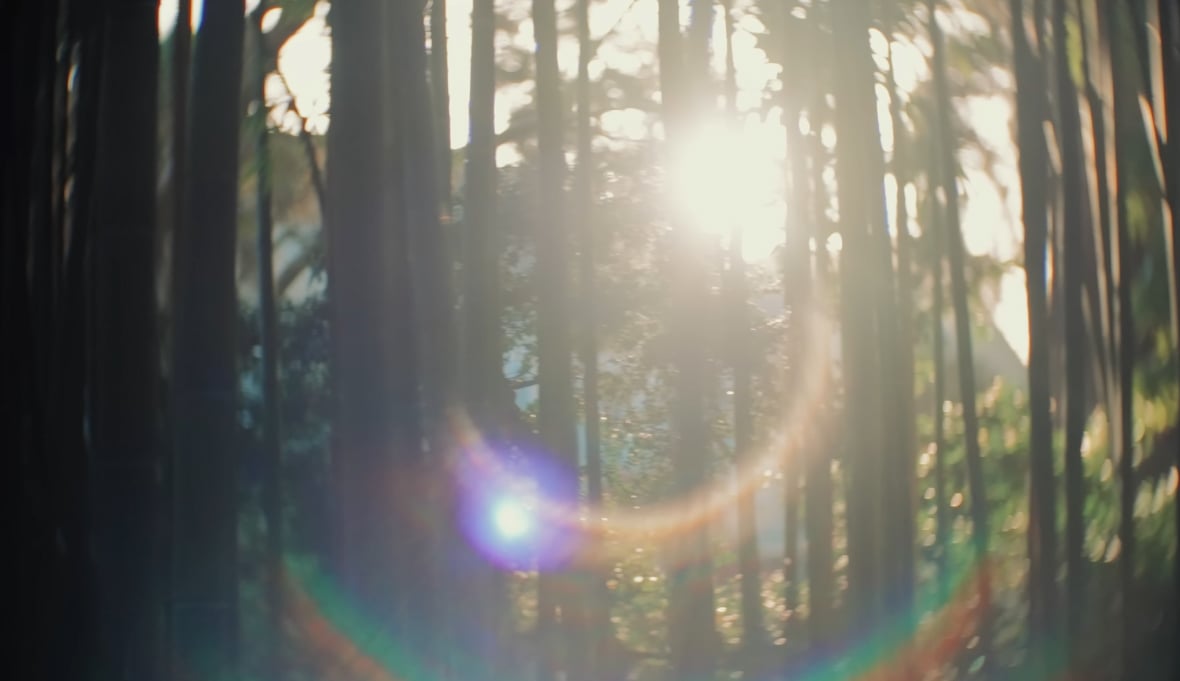
The result? Razor-sharp centers, dreamy swirly bokeh at the edges, rainbow flares, pastel colors, and a magical tunnel effect that turns everyday footage into cinematic poetry. Stern describes shooting with this lens as like peering through a time portal. A $10 lens, once destined to quietly project images in an old theater, now captures the world like a long-lost masterpiece. Its quirks, slight halo in macro and uneven edge sharpness, are not flaws. They are the character, the soul, the cinematic fingerprint of a lens that has seen history.


Lessons from Mathieu Stern’s Find
This story is a reminder to always stay open to happy accidents. Sometimes the universe or eBay rewards patience, knowledge, and curiosity. And if you want to explore this rabbit hole of forgotten optics, there is a whole world waiting: projector lenses, swirly bokeh, and the thrill of $10 cinematic miracles.
Because in this tale, Mathieu Stern is The Chosen One, getting a lens many analog enthusiasts dream of by mistake. And that, dear reader, is pure magic.
Image credits: Mathieu Stern