Only Known Photos of Hamburg’s Jewish Deportation Discovered in Secret Album

The only known photographs of the deportation of the Jewish population in the German city of Hamburg have been discovered in a German police officer’s secret photo album.
Until now, no visual record of the deportations from Hamburg was known to exist. But researchers have now identified three photographs taken in October 1941.
For 84 years, these images remained hidden in the private album of a German policeman who served in Unit 101 of the Ordnungspolizei, or “green police,” a unit involved in deporting and murdering tens of thousands of Jews during the Holocaust. However, the policeman’s personal file indicates he was not a member of the Nazi Party or the SS.
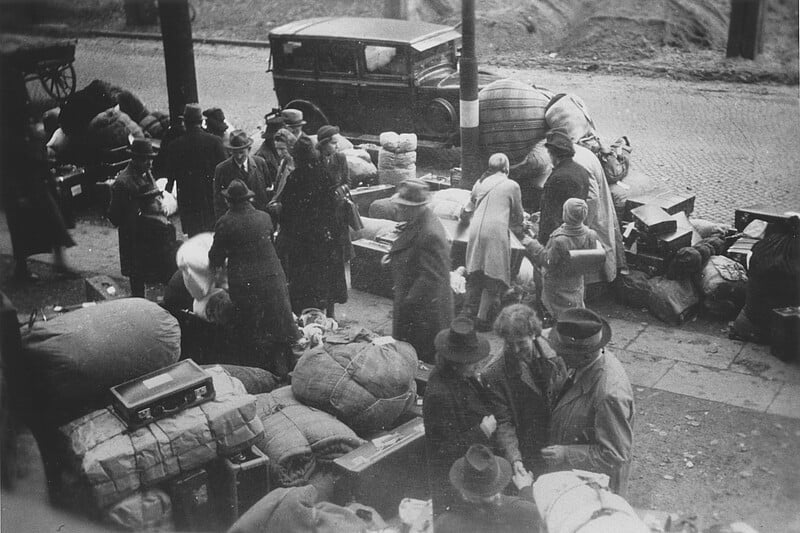
In October 1941, 1,304 Jews from Hamburg were deported to the Litzmannstadt Ghetto, according to a news release from the Foundation of Hamburg Memorials and Learning Centres. The Gestapo issued written orders for men, women, and children to report to an assembly point at Moorweidenstraße 36. At the Logenhaus, they were subjected to humiliating searches and theft of personal belongings. After spending the night in overcrowded and poor conditions, the deportees were transported by Hamburg police vans to the Hannoverscher station and then sent to the Litzmannstadt Ghetto, also known as the Łódź Ghetto, in occupied Poland. When the ghetto was liquidated in 1944, the remaining inhabitants were deported to Auschwitz. Only nine of the original group survived the war.
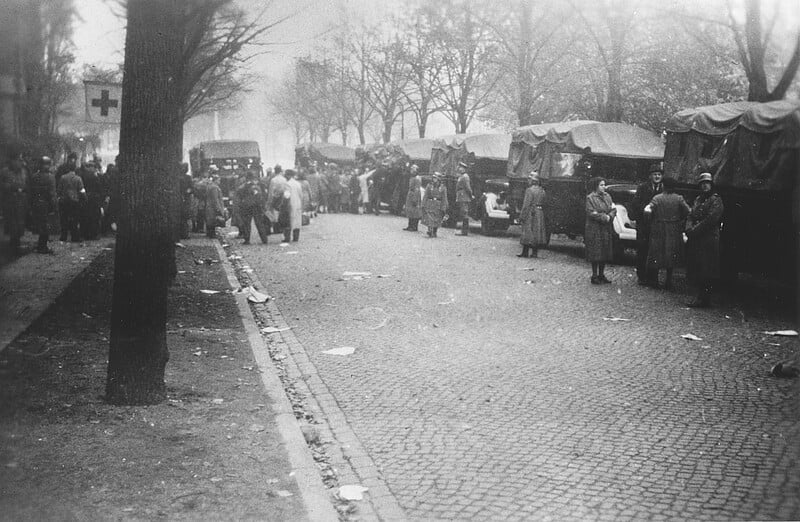
According to the Israeli newspaper Haaretz, one of the discovered photographs shows roughly 20 individuals at the foot of a building, with some wearing Nazi uniforms and others armbands indicating membership in Jewish organizations. Another image offers a closer view of the luggage, and a third captures a convoy of military trucks onto which the deportees are being loaded. The new outlet reports the photographs were previously misidentified as images of German civilians being evacuated after Allied air raids. They were catalogued this way in the archive of the U.S. Holocaust Memorial Museum in Washington.
Dr. Alina Bothe, director of the “#LastSeen: Pictures of Nazi Deportations” project at the Free University of Berlin, believes the discovery could lead to further finds. She notes that photographs documenting deportations from across the Reich and other parts of Europe may still exist in archives or private collections.
“For two cities — Berlin and Frankfurt — the lack of images is especially astonishing,” she tells Haaretz. “Ten percent of people in Germany in the 1930s owned cameras — that makes for at least 400,000 cameras in Berlin… So, where are the images from Berlin?”
Image credits: All photos via United States Holocaust Memorial Museum in Washington (USHMM).