Is the Canon C50 the R5 C Successor People Have Been Waiting For?

Canon unveiled the EOS C50 this morning and the new RF mount-equipped full-frame cinema camera, Canon’s smallest and lightest Cinema EOS series camera to date, seems like it could be the awaited successor to the Canon EOS R5 C hybrid camera. But is it? Let’s see how the two cameras face off.
Canon EOS C50 Versus R5 C: Body Design
When Canon launched the R5 C in 2022, it described the camera as a photo and video camera in one, a true hybrid camera. The new EOS C50 is both a photo and video camera, too, but rather than perform both tasks equally well, it prioritizes video. The C50’s body design reflects the shifted priorities.

Many of the most significant differences between the C50 and R5 C come down to their respective designs. The new Canon C50 sports a fairly video-friendly camera design, meaning that it ditches a viewfinder. C50 users compose their shots using the camera’s articulating 3-inch touchscreen.
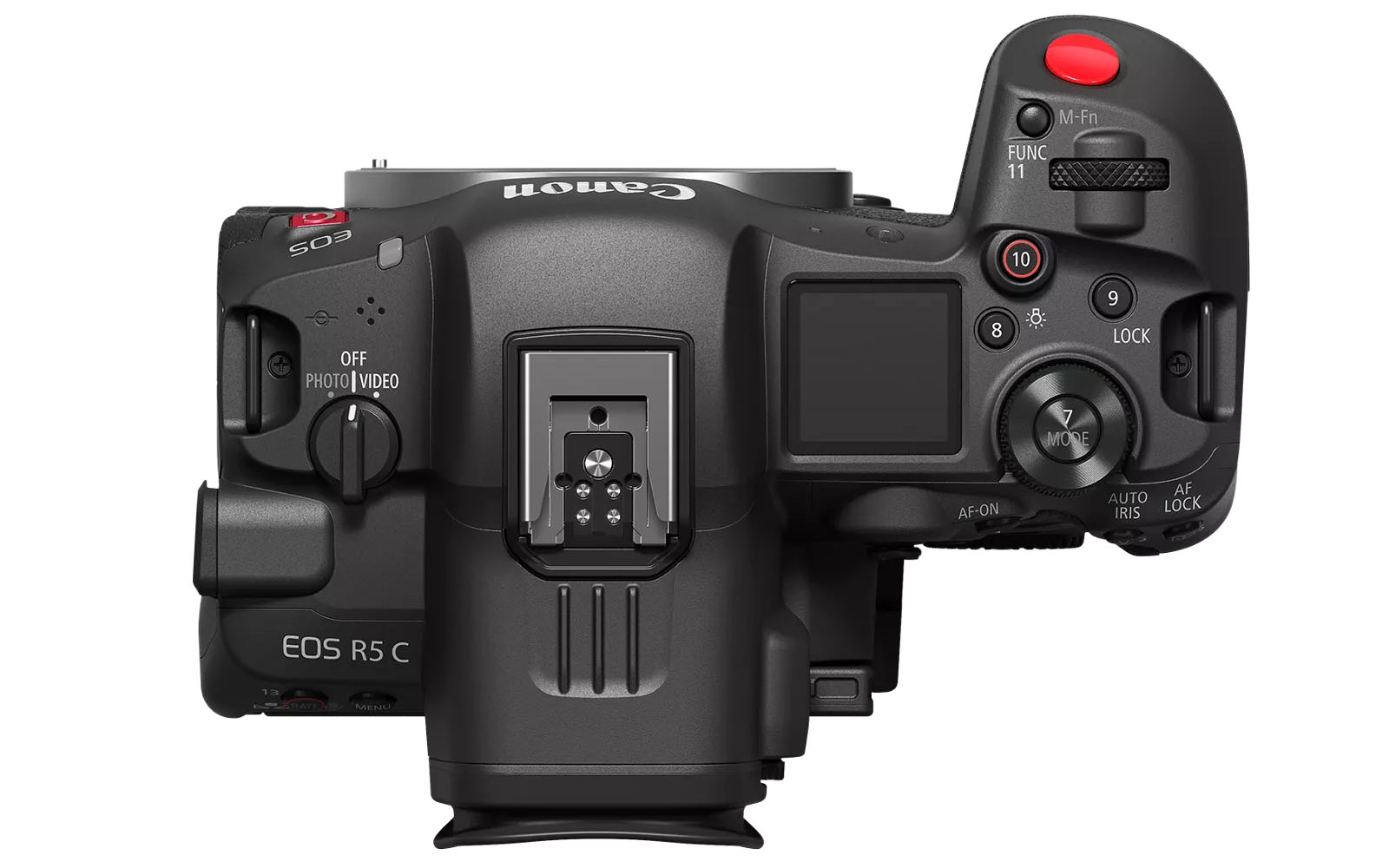
The R5 C, in contrast, looks a lot like the Canon EOS R5 it is built on, albeit with a larger body design to account for its active cooling — which the EOS C50 has as well, by the way. The R5 C features a 5.79-million-dot OLED EVF with 0.76x magnification. It also features a slightly larger touchscreen — 3.2 versus 3.0 inches.
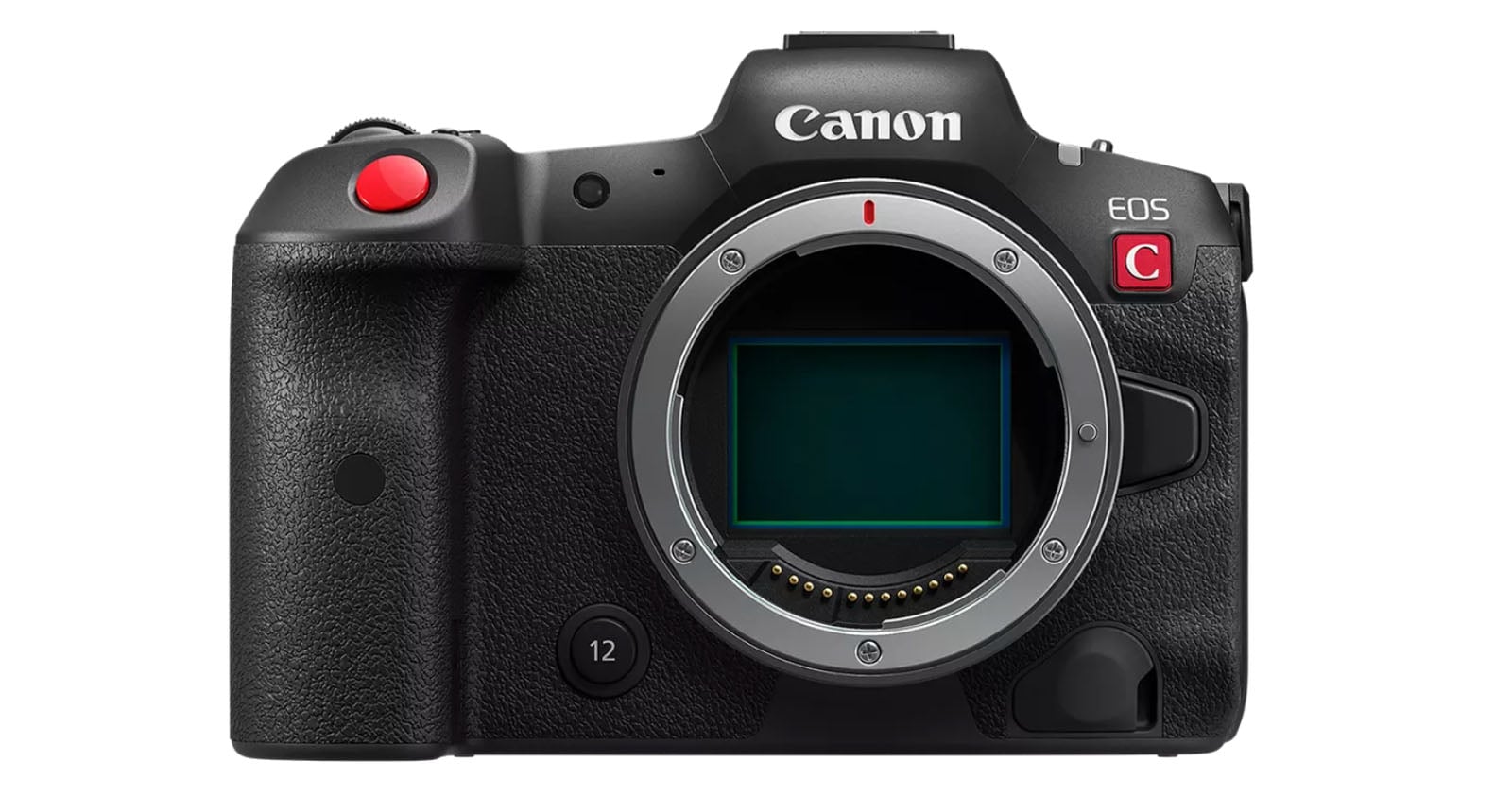
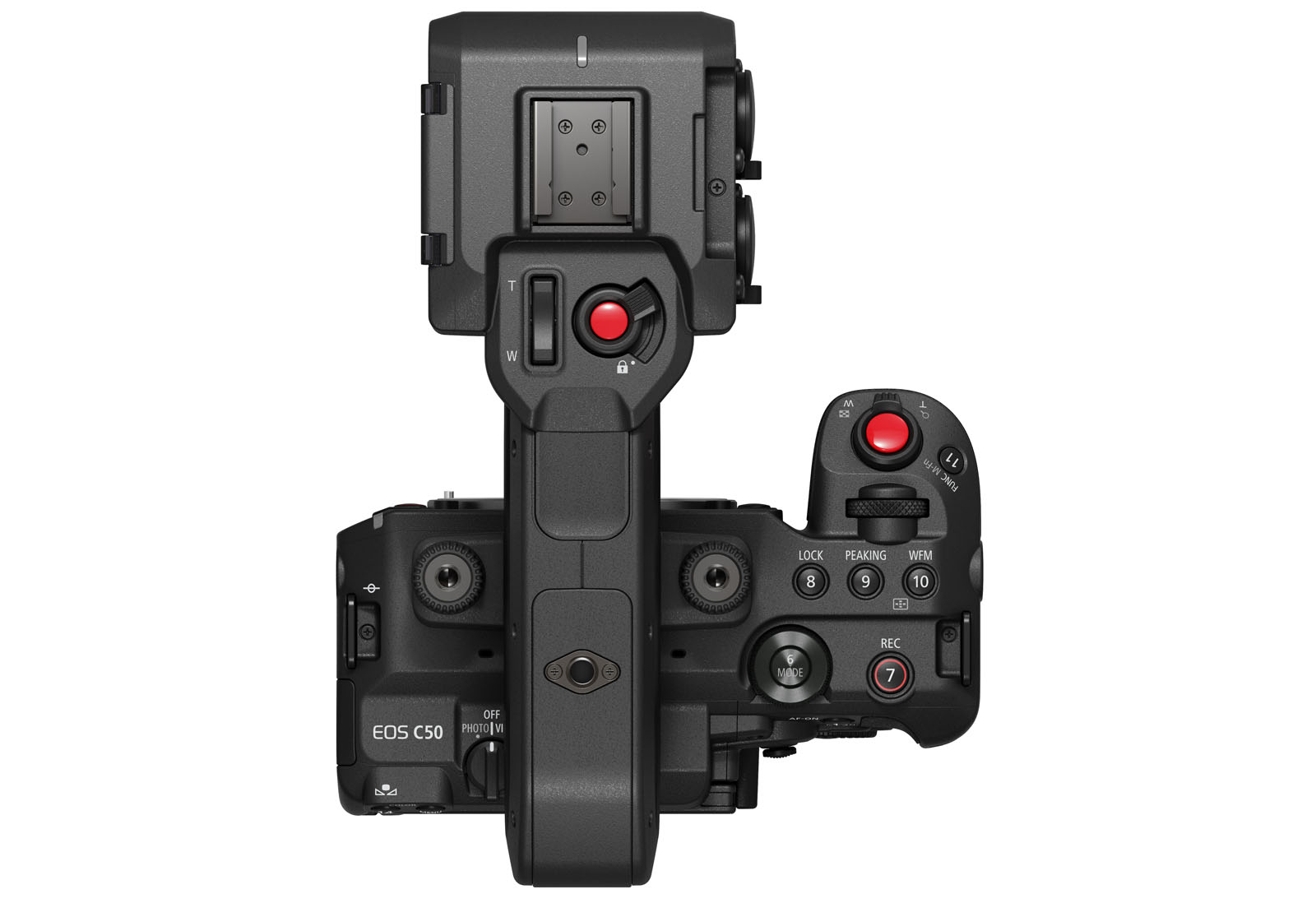
By removing the viewfinder and top display found on the EOS R5 C, Canon has been able to make the C50 fit better into a professional video workflow. The C50, which ships with a top handle, has a pair of 1/4-20 mounting points on the top of the camera, plus more on either side. It also features mount adapter lock plate screw holes, which the R5 C lacks.
The C50 also swaps from the Micro HDMI terminal on the R5 C to feature a full-size HDMI port. The C50 also includes a zoom rocker switch on the camera and on its included handle attachment, which can be used to electronically adjust the focal length of power zoom-equipped RF lenses like the RF 24-105mm f/2.8 L Z and 70-200mm f/2.8 L IS USM Z.

In terms of their overall size and weight, the R5 C weighs 770 grams (1.7 pounds) with battery and recording media and is 142.2 by 101.6 by 111.8 millimeters (5.6 by 4 by 4.4 inches). The Canon EOS C50 weighs 665 grams (1.5 pounds) and measures 143 by 88 by 95 millimeters (5.6 by 3.5 by 3.7 inches) without the attached handle unit.
Canon EOS C50 Versus R5 C: Photo and Video Capabilities
The differences between the C50 and R5 C continue beneath the surface. The new C50 features a brand-new 32-megapixel full-frame CMOS image sensor, while the R5 C incorporates the 45-megapixel CMOS sensor from the original R5.
While this obviously means that the two cameras capture different megapixel photos, it also impacts their maximum video resolution. Unlike the R5 C’s sensor, the C50’s new imager lacks the necessary megapixels to record 8K video. The C50 tops out at 7K resolution, which is at least sufficient for cropping to 4K or 6K output, but may not meet all users’ needs.
However, the C50 can record full-frame (3:2) open gate video, something no other Cinema EOS camera has offered before. This provides users with additional cropping flexibility during post-production and also enables the use of 1.5x full-frame anamorphic lenses.

The C50 also has simultaneous recording modes for different aspect ratios. It’s possible to record landscape video to the CFexpress card while a vertical crop to the camera’s SD card. This is another first for a Canon EOS Cinema camera.
The C50’s new 32-megapixel sensor promises up to 16 stops of dynamic range thanks to its Dual Base ISO (800 and 6400 in Canon Log 2), whereas the R5 C tops out at 14 stops. The Canon R5 C’s Dual Base ISO is 800 to 3200 in Canon Log 3. The R5 C doesn’t have C-Log2 at all.
In the years since the R5 C arrived, Canon has developed Dual Pixel CMOS AF II. This enhanced autofocus system, featuring AI-based subject detection, promises improved speed and accuracy. While the R5 C’s autofocus is nothing to scoff at, the C50’s performance should be better.

For photographers, the C50 can capture continuous RAW images with autofocus at up to 40 frames per second and includes pre-release continuous shooting. The R5 C is slower, but still very fast at 20 frames per second. However, the R5 C lacks pre-capture release.
What the C50 and R5 C Have in Common
While this has thus far not been an exhaustive list of all the differences between the C50 and R5 C, but rather an overview of some of the biggest differences between the two cameras, the two models do have many features in common.
They both have Time Code support, active cooling, dual CFexpress and SD card slots, HDR recording, XLR support (via adapter for the R5 C and using the top handle on the C50), and Frame.io Camera to Cloud functionality, to name just a handful of shared features.

Both cameras also have a wide array of customizable buttons, although the C50 increases the count from 13 to 14 compared to the R5 C.
Is the Canon EOS C50 the Successor to the EOS R5 C?
Among the biggest questions that Canon users will have now that the EOS C50 has been unveiled is whether or not it’s the successor to the R5 C. The answer is predictably complicated given that the C50 is not called the R5 C II. Further, the R5 C is not going anywhere. Both cameras will exist alongside each other in Canon’s EOS lineup.
However, in PetaPixel‘s view, a true R5 C successor is likely not a priority for Canon. While some people prefer the traditional SLR-style body for video work, a glance across the landscape of compact cinema cameras shows that a design like the C50 is more in vogue. It may not be what all the people want, but it’s certainly what they get these days.

The Canon EOS C50 seems to fit better into a wider range of video-focused workflows than the R5 C does, and the various refinements make the C50 a more compelling option for many users, at least those who don’t require 8K recording. The C50 is smaller, lighter, faster, more expandable, and has a broader range of professional workflow features than the R5 C.
The C50 is not quite a sequel to the R5 C, although it does offer many relative advantages over the R5 C. It also doesn’t serve the same exact audience. The R5 C reasonably successfully wears both hats, photo and video. The EOS C50 does not entirely abandon photography, but its lack of an EVF and inability to use flash thanks to the removal of a mechanical shutter — a problem the R5 C doesn’t have — reflect its video-first chops. The R5 C was an actual hybrid camera, while the C50 is arguably a video camera that shoots photos.
There is something here worth noting about the EOS C50’s photography features, though. Its 32-megapixel full-frame image sensor may be tuned for video, at least in terms of its Dual Base ISO with C-Log 2, but it is a 3:2 image sensor that can capture RAW photos with full AF at 40 frames per second. Wouldn’t that be a nice suite of features for a Canon EOS R6 Mark III? That is, of course, speculation, but the R6 II and its 24.2-megapixel sensor are starting to feel a little long in the tooth compared to something like the 32.7-megapixel Sony a7 IV. Just saying.
Image credits: Canon. Header photo created using an asset licensed via Depositphotos.