Nikon in 2025: Another Excellent Year for a Resurgent Nikon
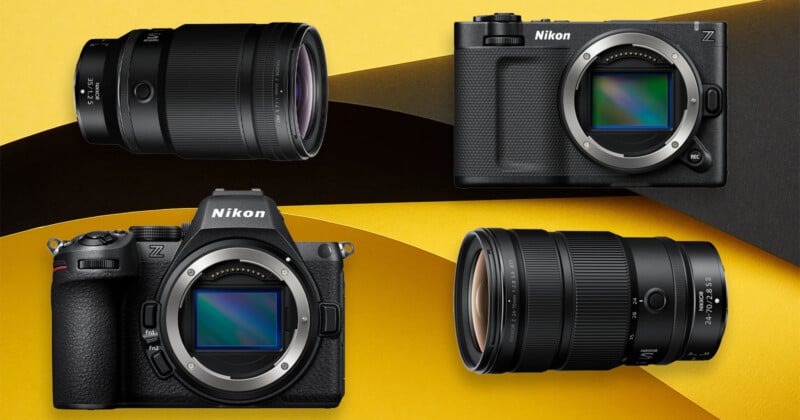
Nikon’s 2024 acquisition of RED bore its first major fruit this year, but the RED-infused Nikon ZR is far from the only great product the legendary Japanese company released in 2025. Nikon launched three cameras and five lenses, nearly all of which proved impressive.
As a recap, Nikon launched the Z6 III, Z50 II, and three great lenses in 2024. The company also acquired cinema company RED for just $85 million. Although RED-developed LUTs for high-end Nikon cameras arrived last year, 2025 marked the debut of the first Nikon camera with obvious RED influence in the form of the ZR. The ZR is far from the only exciting product Nikon released this year, though. Let’s take a closer look at Nikon’s work in 2025 and see if the company can best its impressive B+ grade from last year.
Two Excellent Cameras and a Slightly Tweaked Superzoom
Nikon’s first camera of 2025 was an interesting one, the Coolpix P1100. This all-in-one superzoom bridge camera sports a crazy 125x optical zoom lens with an equivalent range of 24-3000mm. The camera’s 16.8-megapixel sensor is relatively small, just a Type 1/2.3, but what can one expect with a 24-3000mm lens?

The Nikon P1100 is fundamentally very similar to 2018’s Coolpix P1000, but it does include a few noteworthy new features. The new model has a selectable AF-area mode in its Bird Watching Mode, adds a fireworks mode, and adopts a USB-C port.

The Coolpix P1100 is not a groundbreaking camera or a novel refresh of the original P1000. Still, it is a nice, albeit minor update that helps ensure that the impressive superzoom camera remains accessible and easy to purchase for photographers in 2025.
While the Coolpix P1100 isn’t super exciting, Nikon’s second camera of 2025 sure is: The Nikon Z5 II.
Announced in early April, the Nikon Z5 II promises a lot of performance at a very accessible price point of around $1,600. The camera delivers on this promise, giving photographers a full-frame camera with high-end features at a budget-friendly price. Although the Z5 II is technically Nikon’s entry-level full-frame camera, its performance goes far beyond entry-level.
“I loved my time with the Nikon Z5 II because I never felt under-gunned. The original Z5 was designed to meet a certain price and as capable as it was, there were some unavoidable compromises made to get there. However, the Nikon Z5 II feels totally different,” Chris Niccolls writes. “This is a true jack-of-all-trades with quality hardware throughout. It can handle everything from landscapes to sports to wildlife and would be equally at home as a professional wedding camera.”

If not for the fact that the Canon R6 III and Sony a7 V launched this year, the Nikon Z5 II would have been named PetaPixel‘s Camera of the Year. It nonetheless earned an “Official Selection,” and deserves every bit of praise it has received. The Nikon Z5 II shows that a full-frame mirrorless camera doesn’t have to cut any meaningful corners to hit a sub-$2,000 price point.
Nikon’s third and final camera of 2025, the Nikon ZR, is its first model to incorporate RED technology. The video-first hybrid camera boasts the Z6 III’s excellent, partially stacked sensor, a large rear display, great IBIS, and high-end video features, all at an aggressive price of just under $2,200.
It is little surprise that the ZR soared to the top of Japanese sales charts shortly after its launch. Nikon itself believes the ZR is so capable and versatile that it fills roles often occupied by multiple product lines.
The Nikon ZR not only stands on its own as an excellent video-oriented hybrid camera, but also lays a strong foundation for how Nikon and RED technologies can meld in future products. In well under two years, Nikon has gone from something of an afterthought in the video space to a very powerful force that still has plenty of room to grow.
Nikon’s Optical Excellence Continued in 2025
Although Nikon’s first lens of the year was announced in 2024, the Nikon 28-135mm f/4 PZ didn’t receive an official release date until February. The lens then arrived in April, and immediately impressed.
Although the timing is convenient, Nikon’s first-ever full-frame video lens was in the works long before the company acquired RED. The 28-135mm PZ, as its name suggests, features an internal motor to deliver power zoom to video creators. It also features a video-oriented design, complete with a square lens hood, geared focus ring, and power zoom rocker. It also bucks standard Nikkor Z lens aesthetics by incorporating Nikon’s legendary gold ring, once a mainstay on the company’s high-end SLR and DSLR optics.
What is most impressive of all about the 28-135mm f/4 PZ is its optical performance. The lens delivers great bokeh, excellent resolution, and well-controlled focus breathing.
“I truly enjoyed my short time with the Nikon Z 28-135mm f/4 PZ, and look forward to shooting future projects on it when the lens becomes available in the Spring. While the $2,600 price puts this lens out of reach for many amateurs, it is in line with competitive offerings like the aforementioned $3,100 Sony 28-135mm f/4 PZ. A power zoom is a creative tool that has long been missing from Nikon’s optical lineup, and the addition of this lens means there’s even more reason for videographers and cinematographers to give a long hard look at Nikon’s Z-Mount lineup,” PetaPixel‘s Jordan Drake concluded in his hands-on impressions of the new cinema lens.
Announced in early February, the Nikon Nikkor Z 35mm f/1.2 S is a big, beautiful, and expensive fast prime lens. While the lens didn’t win anything in the PetaPixel Awards this year, I will note that it definitely received some love from voters. The lens is so good it even won over noted 35mm hater Chris Niccolls.
“Regardless of whether you like the 35mm focal length or not — and I know most of you do — there is no denying that the new 35mm f/1.2 is optically superb. I did not hate this lens even though I generally dislike the focal length. In fact, I kinda loved it,” Niccolls wrote.
Nikon went quite a while before releasing its next lens, the Nikon Nikkor Z 24-70mm f/2.8S II. The new standard zoom lens had mighty big shoes to fill, as the original Nikkor Z 24-70mm f/2.8 S is a legend. However, Nikon didn’t just deliver a better-performing lens, a tall task indeed, but it did so while breaking new ground for 24-70mm f/2.8 lenses altogether.
The Nikon Nikkor Z 24-70mm f/2.8 S II is the lightest 24-70mm f/2.8 lens on the market and the first of its kind to feature an internally zooming design, making it as good for video as it is for photography.
“This new Nikon lens seems to achieve an incredibly high level of optical performance throughout its focal range and has essentially no bad qualities. It’s versatile, fast focusing, and sharp, which is exactly what you want out of a professional lens,” Chris Niccolls writes.

The Nikon Nikkor Z 24-70mm f/2.8 S II was named an “Official Selection” in this year’s PetaPixel Awards.
Nikon’s final two lenses of 2025 are both Nikkor Z DX models. While the new Nikkor Z DX 16-50mm f/2.8 VR and Nikkor Z DX MC 35mm f/1.7 lenses don’t move the needle at all for full-frame photographers, they address a major shortcoming in the Nikkor Z lens system.


The Nikkor Z DX 16-50mm f/2.8 VR offers APS-C shooters a 24-70mm f/2.8 equivalent lens in a smaller, lighter form factor, while the DX MC 35mm f/1.7 is essentially a “nifty fifty” with macro capabilities. These are both great additions to Nikon’s lineup.
It’s about time Nikon gave APS-C photographers some fast, high-quality lenses to choose from rather than the typical slower kit lenses. While I don’t necessarily expect Nikon to release many more high-end DX lenses, I’m happy these two new ones exist.
Grading Nikon in 2025
Last year, I gave Nikon a B+ for its efforts. 2024 was undoubtedly a good year for Nikon, but I think 2025 was actually even better, albeit only slightly. The company’s Z5 II is an incredible full-frame camera, and the ZR is a highly competitive, affordable video-oriented camera. Nikon’s lenses in 2025 were even better than their glass in 2024.
2025 helped cement the Nikon Z system as a highly capable, versatile option for an even wider range of photographers and videographers. While I am still (impatiently) waiting for the long-awaited Nikon Z9 II, Nikon’s resurgence continued this year, and the company is in a strong position heading into 2026. It will be an important year for Nikon, but if 2025 is any indication, the company is up to the challenge.
Grade: A-
Image credits: Nikon. Header photo created using an asset licensed via Depositphotos.